|
Waseda University Team Sheds Light on Self-organization of Biological Structures
TOKYO, Nov 29, 2013 - (ACN Newswire) - Researchers at Waseda University in Japan have identified key information to help explain the formation of the "spindle apparatus", a structure required for cell division. Their findings shed light on the mechanisms behind "self-organization" - an essential characteristic of biological structures.
 | | Waseda University Team Sheds Light on Self-organization of Biological Structures |
Organisms are composed of a variety of structures including muscles, internal organs, and brains, all of which are created through a process known as self-organization. In a study published in the online journal, Cell Reports, the research team examined how the spindle apparatus self-organizes. Composed of fibrous molecules called microtubules, this structure is responsible for the segregation of chromosomes between daughter cells.
Researchers around the world are interested in the mechanisms of spindle formation because if chromosome segregation does not take place correctly in human cells, the process can cause cancer or birth defects. Previous studies have identified molecular motors and a range of other molecules involved in spindle formation. But certain fundamental data remain missing, particularly concerning the relationship between the amount of microtubules and the size and shape of spindles
Using fluorescence microscopy, Jun Takagi and his colleagues at Waseda University observed self-organizing spindles from the eggs of aquatic frogs. Based on their observations, the team derived a simple mathematical model describing the relationship between the size and shape of the spindle apparatus and the density and amount of microtubules. This successful characterization of the key parameters that determine spindle structures during self-organization is particularly useful in understanding the physical mechanisms of 'self-organization' in orderly structures.
BACKGROUND AND PURPOSE OF THE STUDY
Organisms are composed of a variety of structures including muscles, internal organs, and brains, all of which are created through a process known as self-organization. In the present study, our focus was on the spindle apparatus, a structure responsible for the segregation of chromosomes between daughter cells. The spindle apparatus is formed by self-organization, through molecular-motor assisted assemblage and orientation of fibrous polymers called microtubules. Many researchers around the world have been studying the mechanisms of spindle formation because, if chromosome segregation does not take place correctly, it can cause cancer or birth defects. Previous studies have identified molecular motors and a range of other molecules involved in spindle formation. Certain fundamental data remain missing, however, particularly on the relationship among the amount of microtubules and the size and shape of spindles. Our aim was to investigate the quantitative relationship among those parameters by using physical techniques.
- Techniques developed during the study
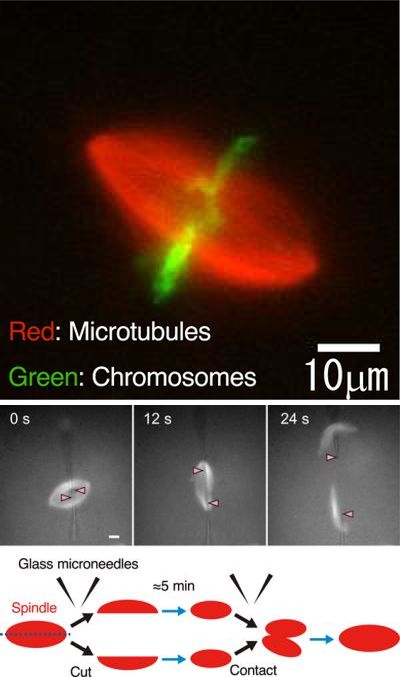
Spindle apparatus assumes a 3D structure and, in metaphase, it looks like a rugby ball (see Figure 1 above). While most previous studies used epifluorescence microscopy to observe spindles two-dimensionally, we employed 3D observation using confocal fluorescence microscopy in order to determine the size and shape of spindles more accurately. Thanks to the 3D observation approach, we were able to perform quantitative analysis of 3D asymmetry in deformed spindles. Additionally, fluorescence labeling of microtubules allowed accurate measurement of spindle volume and the amount and density of microtubules in each spindle.
We also established a technique for cutting a spindle into two halves using glass microneedles (<1 um in tip diameter) (Figure 2). It is generally impossible to directly manipulate spindles under microscope, because spindles are contained in cells. Fortunately, spindles (30 to 50 um in length) that self-organized in Xenopus egg extracts, as used in our study, have no cell membranes around them, permitting direct manipulation. A physical technique such as cutting was desirable, as it did not affect properties of the media surrounding the spindles during direct manipulations of spindle size and shape besides microtubule amount and density.
- Results and conclusions drawn from the study
Our 3D observation of metaphase spindles that self-organized in Xenopus egg extracts revealed that spindle shape and microtubule density were constant irrespective of spindle size, whereas spindle size was correlated with the microtubule amount. We quantitatively defined the spindle shape and the microtubule density, based on which we successfully derived a simple equation describing the relationship among all the parameters. In this equation, spindle size is explained by microtubule amount in addition to the other parameters that are independent of spindle size (i.e., the spindle shape and microtubule density).
When a spindle was cut into two fragments using glass microneedles, each fragment regained its original spindle shape and microtubule density within five minutes of cutting (Figure 3). This indicates that the independent associations between spindle size and spindle shape or microtubule density was maintained even in the cut fragments. Regarding the microtubule amount in each fragment, it was reduced by half or more due to cutting and, at the same time, each fragment became smaller than the original spindle. These findings again indicate preservation of the correlation between spindle size and microtubule amount in the cut fragments. Furthermore, when two cut fragments were allowed to contact each other, they fused together and eventually became a single spindle resembling the one before cutting (Figure 3).
These results demonstrate that spindle size is correlated with microtubule amount, and that spindle shape and microtubule density are dynamically maintained and unaffected by the physical intervention of 'cutting.'
- Potentially universal effects and social significance of the study
Our successful characterization of the key parameters that determine spindle structures during self-organization is particularly useful in understanding the physical mechanisms of 'self-organization' in orderly structures. It is also expected to help elucidate how chromosome segregation is precisely achieved, which is of great importance from a biological as well as medical viewpoint. We believe our findings give clues to the mechanisms of self-organization seen in various other biological structures and, eventually, will facilitate designing of artificial structures utilizing biological materials.
The study reported here was conducted with the financial support of a Grant-in-Aid for Scientific Research. The results have been published in an article entitled 'Using micromanipulation to analyze control of vertebrate meiotic spindle size' in Cell Reports, an online journal from Cell Press.
Authors:
-- Jun Takagi, Research Associate, Faculty of Science and Engineering, Waseda University
-- Takeshi Itabashi, Lecturer, Faculty of Science and Engineering, Waseda University
-- Kazuya Suzuki, Ph.D. Candidate, Faculty of Science and Engineering, Waseda University; JSPS (Japan Society for the Promotion of Science) Research Fellow (DC1)
-- Tarun M. Kapoor, Professor, Rockefeller University
-- Yuta Shimamoto, Postdoctoral Fellow, Rockefeller University
-- Shin'ichi Ishiwata, Professor, Faculty of Science and Engineering, Waseda University; and Director, Waseda Bioscience Research Institute in Singapore (WABIOS)
Useful links -
Research paper on Cell Reports: http://www.cell.com/cell-reports/fulltext/S2211-1247%2813%2900544-5
Ishiwata Lab, Department of Physica, Waseda University: http://www.ishiwata.phys.waseda.ac.jp/index.html
Waseda Bioscience Research Institute in Singapore: http://www.waseda.jp/WABIOS/
Media contact:
Ryohei Matsuoka
PR Office
Waseda University
Email: koho@list.waseda.jp
Press release by ResearchSEA on behalf of Waseda University, JAPAN.
Source: Waseda University
Sectors: Science & Research, BioTech
Copyright ©2025 ACN Newswire. All rights reserved. A division of Asia Corporate News Network. |
Latest Release

SAKENOVA: 28-Year-Old Master Brewer Pioneers AI-Driven Sake Revolution, Achieving 40% Cost Reduction While Winning International Gold Medals
Dec 15, 2025 23:00 JST
| 
NEC Provides Vehicle Management Equipment for Autonomous Driving at Tokyo International Airport
Dec 15, 2025 19:41 JST
|
NEC and AEROTHAI Elevate Air Traffic Safety with Advanced Time Sync Solutions from Adtran Oscilloquartz
Dec 15, 2025 19:04 JST
| 
Olympus Triples Venture Capital Fund Investment to Strengthen MedTech Leadership
Dec 15, 2025 08:30 JST
| 
HKTDC 4Q25 Export Confidence Index: 2026 Hong Kong Export Growth of 8-9%, Sustained AI product demand lays solid foundation for future expansion
Dec 12, 2025 23:15 JST
| 
Anime Tokyo Station: A Series of Linked Events to Be Held in Conjunction with the Anniversary Joint Exhibition
Dec 12, 2025 11:00 JST
| 
MHI and Worley to Deliver Full-Scale Carbon Capture Facility for Heidelberg Materials UK's Padeswood Cement Works
Dec 08, 2025 17:00 JST
| 
Honda Technical Support for Red Bull Powertrains in F1 Racing Concludes
Dec 08, 2025 16:34 JST
|
MHIET U.S. Subsidiary's Franklin Plant Celebrates 10th Anniversary
Dec 08, 2025 16:03 JST
| 
Lexus World Premieres Lexus LFA Concept BEV Sports Car
Dec 05, 2025 19:13 JST
| 
TOYOTA GAZOO Racing World Premieres GR GT & GR GT3
Dec 05, 2025 18:58 JST
|
TOYOTA GAZOO Racing and Lexus Hold World Premiere of GR GT, GR GT3, and Lexus LFA Concept
Dec 05, 2025 18:24 JST
|
World's First General Design Approval (GDA) for Developed Steel and Post-Weld Heat Treatment (PWHT) Exemption based on ECA for Low-pressure Liquefied CO2 Tank made of KF460 steel
Dec 05, 2025 18:17 JST
| 
Hitachi at CES 2026: Building a Harmonized Society Through Technology
Dec 04, 2025 19:40 JST
| 
Fujitsu and Scaleway partner to accelerate European sustainable transformation and data sovereignty with FUJITSU-MONAKA CPU-based AI inference
Dec 04, 2025 19:08 JST
|
NEC Orchestrating Future Fund Invests in PopID, Inc. to Accelerate Global Expansion of Biometric Payment Solutions and Launch a Strategic Collaboration
Dec 04, 2025 18:52 JST
| 
Eisai Presents New Data on the Continued and Expanding Benefit of LEQEMBI(R) (lecanemab-irmb) Maintenance Treatment in Early Alzheimer's Disease at CTAD 2025
Dec 04, 2025 18:36 JST
|
The 26th Hong Kong Forum marks successful completion
Dec 03, 2025 22:44 JST
|
New Data Presented at CTAD 2025 Confirms Pharmacological Effect of LEQEMBI(R) (lecanemab-irmb) on Neurotoxic Aβ Protofibrils in CSF
Dec 03, 2025 18:19 JST
| 
Mitsubishi Motors Launches the All-New Destinator in Vietnam
Dec 03, 2025 18:00 JST
|
More Latest Release >>
|