|
NEDO, Sharp, and Toyota to Begin Public Road Trials of Electrified Vehicles Equipped with High-efficiency Solar Batteries
Testing the potential of solar batteries toward CO2 emissions reductions in the transport sector
TOKYO, Jul 04, 2019 - (JCN Newswire) - NEDO, Sharp Corporation (Sharp), and Toyota Motor Corporation (Toyota) plan to commence public road trials from late July 2019. The trials aim to assess the effectiveness of improvements in cruising range and fuel efficiency of electrified vehicles equipped with high-efficiency solar batteries.
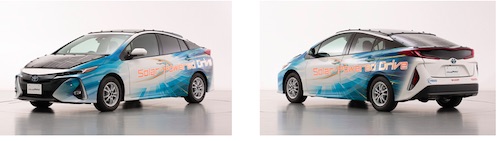 | | Figure 1: Prius PHV demo model equipped with solar battery panel |
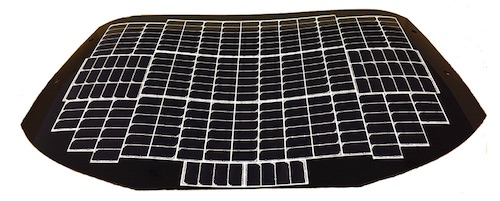 | | Figure 2: Solar battery panel consisting of several solar battery cells (rear hatch door portion) |
To facilitate the execution of this trial, Sharp modularized its world-class, high-efficiency solar battery cells(1) (conversion efficiency of 34%+(2)), previously developed for a NEDO-led project(3), to create an onboard solar battery panel. Toyota installed this panel on the roof, hood, rear hatch door, and other parts of its "Prius PHV" and produced a demo car for public road trials. By enhancing the solar battery panel's efficiency and expanding its onboard area, Toyota was able to achieve a rated power generation output of around 860 W(4), which is approximately 4.8-times higher in comparison with the commercial model Prius PHV (equipped with a solar charging system). In addition to substantially boosting its power generation output, the demo car employs a system that charges the driving battery while the vehicle is parked and also while it's being driven, a development that is expected to lead to considerable improvements in electric-powered cruising range and fuel efficiency.
Toyota plans to conduct the trials under various driving conditions in Toyota City, Aichi Prefecture, Tokyo, and other areas. Various data, including the power generation output of the solar battery panel and the amount the drive battery is charged, will be obtained and verified, and then used in the development of an onboard solar recharging system. Toyota plans to share a selection of trial data results with NEDO and Sharp. The PV-powered Vehicle Strategy Committee(5) (PV: photovoltaic), sponsored by NEDO and other entities will evaluate the benefits based on improvements in CO2 emissions reductions and convenience, such as the number of times a vehicle requires recharging. The goal is to contribute to the creation of a new solar battery panel market, including the transport sector, and find solutions for energy and environmental issues.
Figure 1: Prius PHV demo model equipped with solar battery panel
http://www.acnnewswire.com/topimg/Low_NEDOSharpToyota1%20.jpg
Background
In April 2016, NEDO, a national research and development organization, set up the PV-powered Vehicle Strategy Committee, which is comprised of members from industry and academia. With the goal of finding solutions to energy and environmental issues in the transport sector, the committee's research focuses on solar power systems. Sharp and Toyota are also active committee participants. The achievements the committee has made thus far include estimates(6) on the potential to achieve an output of 1 kW in vehicles, despite the limited space for installing power systems, by using a solar battery module with a conversion efficiency of 30 percent-plus, zero annual recharging depending on usage patterns, and estimated benefits from a reduction in CO2 emissions.
Profile of demo car
The demo car is equipped with a solar battery panel that utilizes several solar battery cells with a conversion efficiency of 34 percent-plus. The shape of the module, environmental durability, surface materials, and other factors are based on specifications for driving trials implemented by Toyota. The solar battery cell is a thin film about 0.03 mm in thickness. This makes it possible to efficiently install the film to fit the curves of parts with limited space, including the vehicle roof, hood, and rear hatch door. The rated power generation output of the demo car is approximately 860 W.
Previously, the Prius PHV charged the driving battery only while the vehicle was parked. However, with improvements in power generation output, the demo car employs a system that charges while the vehicle is being driven. This is expected to boost the BEV-mode cruising range and fuel efficiency significantly.
Figure 2: Solar battery panel consisting of several solar battery cells (rear hatch door portion)
http://www.acnnewswire.com/topimg/Low_NEDOSharpToyota2%20.jpg
Trial Timeline
Toyota plans to share a selection of trial data results with NEDO and Sharp. The PV-powered Vehicle Strategy Committee and other entities will evaluate the benefits from improvement in the reduction of CO2 emissions and the improvement in convenience, including the number of times a vehicle requires charging. The goal is to further contribute to the creation of a new solar battery panel market, including the transport sector, and find solutions for energy and environmental issues.
- 1) High-efficiency solar battery cell :
Development of the above cell was carried out by a NEDO-led project. Applications were envisaged for the power generation business to achieve a cost of YEN7/kWh. The project aims to focus on the high conversion efficiency rate and verification of its potential for use in vehicles.
https://www.nedo.go.jp/english/news/AA5en_100070.html
- 2) Conversion efficiency of 34%+ :
Calculated based on cell output (as measured by Sharp) under AM1.5 G standard solar battery test conditions as stipulated by international standards.
- 3) NEDO project :
Project Development of high performance and reliable PV modules to reduce levelized cost of energy; research and development of innovative new structure solar cells; research and development of ultra-high efficiency and low-cost III-V compound semiconductor solar cell modules Period FY 2016 to 2020
- 4) Approximately 860 W :
Total module output based on calculation of cell output (as measured by Sharp).
- 5) PV-powered Vehicle Strategy Committee :
Established by NEDO in April 2016 to conduct research and investigate automotive photovoltaic systems with the goal of further contributing to finding solutions for energy and environmental issues and to create new markets.
- 6) Estimates :
Examined the (1) benefits of CO2 emissions reduction, (2) user convenience (number of times the vehicle requires charging), and (3) benefits of CO2 emissions reduction to society at large when the use of PV-powered vehicles is wide spread. The results were published in an interim report released in January 2018. (https://www.nedo.go.jp/english/news/AA5en_100358.html)
Contact:Public Affairs Division
Global Communications Department
Toyota Motor Corporation
Tel: +81-3-3817-9926
Source: Toyota Motor Corporation
Sectors: Automotive, Environment, ESG, Alternative Energy, Automation [IoT]
Copyright ©2026 JCN Newswire. All rights reserved. A division of Japan Corporate News Network. |
Latest Release

Hitachi expands its work with OpenAI to accelerate AI-driven modernization and cybersecurity
Jun 17, 2026 14:54 JST
| 
Fujitsu and IBM Japan collaborate on modernization to support enterprise digital transformation
Jun 17, 2026 14:23 JST
| 
Sharp to Introduce AQUOS R11 Smartphone
Jun 17, 2026 13:59 JST
| 
Honda to Begin Supplying Three High-output Models of the eGX Electric Power Unit Series for Commercial-Grade Work Equipment
Jun 17, 2026 13:44 JST
| 
Eisai Announces Strategic Investment Supported by the UK Government's LSIMF
Jun 17, 2026 13:28 JST
| 
BAE Systems and NEC Sign MoU to Strengthen Japan's Active Cyber Defence
Jun 17, 2026 13:10 JST
| 
Anime Tokyo Station Early Summer Festival
Jun 17, 2026 11:00 JST
| 
Accrelist Appoints Derek Cheong as Chief Executive Officer
Jun 17, 2026 10:10 JST
| 
Japantastics Introduces Sato Mokko to the World -- A New Chapter in Japanese Artisanal Craftsmanship
Jun 16, 2026 18:00 JST
|
Hitachi Energy expands zero-emission power portfolio with HyFlex Compact
Jun 13, 2026 00:06 JST
|
Hitachi Energy unveils AxoniQ: game-changing solution for the next era of transmission grids
Jun 12, 2026 23:42 JST
| 
Team Mitsubishi Ralliart Confirms Triton Readiness as It Targets Second Consecutive AXCR Title
Jun 12, 2026 23:20 JST
|
Report verifying the net carbon impact of NEC's agricultural solution, CropScope, published as part of the Net Carbon Impact initiative promoted by the EU Green Digital Coalition
Jun 12, 2026 21:40 JST
|
NEC's Face Recognition Walkthrough Gate for JR East railways wins "Best of the Best" at the "Red Dot Design Award 2026"
Jun 12, 2026 13:29 JST
|
Mitsubishi Motors to Launch All-New Eclipse Sportback EV in the United States and Canada
Jun 10, 2026 23:15 JST
|
Bosch Home Comfort Group and Hitachi Group agree to collaborate on Intelligent connectivity and diagnosis solutions for Commercial Air Conditioning based on "HMAX for Buildings"
Jun 10, 2026 22:47 JST
|
Hitachi and Google Cloud expand strategic alliance to accelerate real-world deployment of physical AI through FDE and advanced cybersecurity solutions
Jun 10, 2026 22:18 JST
| 
Toyota to participate in the "1000 Miglia Gran Turismo Experience 2026," a special program of the historic Italian rally, the 1000 Miglia
Jun 10, 2026 21:39 JST
| 
Mazda Advances Toward Commercialization of Onboard CO2 Capture System
Jun 09, 2026 00:03 JST
| 
Collaboration Between OCTARVIA Programs and MiPoLin(R)
Jun 08, 2026 23:34 JST
|
More Latest Release >>
|