|
Fujitsu Develops Blockchain-based Exchange System for Electricity Consumers
Contributes to stable electricity supply through energy control in peak periods
TOKYO, Jan 30, 2019 - (JCN Newswire) - Fujitsu Limited and Fujitsu Laboratories Ltd. have applied blockchain technology to develop a system for trading related to energy shortages and surpluses among electricity consumers, including factories and retail stores.
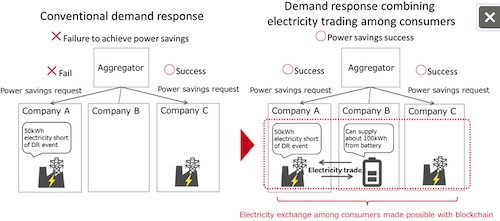 | | Figure 1: Image of consumers exchanging electricity in demand response |
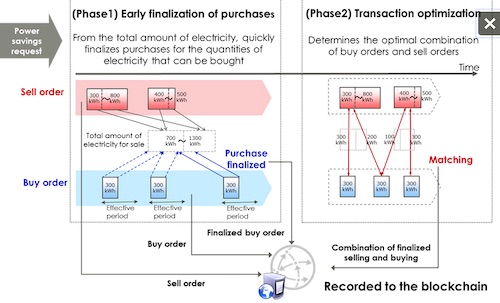 | | Figure 2: Outline of technologies for electricity exchange transactions among consumers |
Demand response (DR) is a scheme in which electric utilities and consumers of electricity cooperate to control the amount of electricity used during periods of expected peak demand. An issue, however, is that the success rate for DR controls can be low, with consumers being unable to meet the amount of power savings requested by electric utilities.
Fujitsu has now devised a system in which electricity consumers can efficiently exchange among themselves the electricity surpluses they have produced through their own electricity generation or power savings. The company then applied blockchain, and with the cooperation of ENERES Co., Ltd., the system was used in a simulation using the actual data of electricity consumption. The result was an approximately 40% improvement to the DR success rate.
Improvement to the DR control success rate is expected to lead to more consumers participating in DR schemes. Moreover, this will enable the stable supply of electricity and the expansion of renewable energy use, another goal of the DR scheme. Fujitsu Limited and Fujitsu Laboratories will carry out further system verification and strive to build a carbon-free society.
Details of the new technology will be showcased at the ENEX 2019 Energy and Environment Exhibition, being held from Wednesday, January 30, to Friday, February 1, at Tokyo Big Sight.
Development Background
Demand response has been in the spotlight as renewable energies and other initiatives are being put in place to develop a carbon-free society. DR, in which electric utilities and electricity consumers cooperate to control the amount of electricity use, aims to reduce electricity consumption, particularly at peak times when shortages of electricity supply are expected, by paying compensation to electricity consumers who contributed to power savings.
In practice, DR is arranged so that an aggregator, who receives the request for power savings from the electric utility and controls the amount of each consumer's power savings, acts as the middleman, and assigns amount of the consumer's power savings. When the amount of power savings requested is achieved, the aggregator receives remuneration from the electric utility.
The aggregator also distributes the remuneration to contributing consumers based on the amount of the power savings they achieved. However, consumers are sometimes unable to meet request from the aggregator, due to shortages in the electricity produced when they operate their own generator or due to sudden spikes in their energy consumption, so there are cases of consumers being unable to receive compensation.
In order to realize a carbon-free society, it is important to increase the success rate of DR, which indicates the ratio of consumers who are compensated for achieving their power savings targets. It is also essential to secure an investment effect when consumers have joined the DR scheme and to increase the number of participants.
Issues
At present, the aggregator interacts with individual consumers on a one-to-one basis to allot power savings amounts and to confirm whether the request can be acceptable for the consumer. For electricity consumers to achieve their power savings targets with a high probability, it can be expected that an exchange that allows a consumer who is short of meeting its targets to quickly exchange a portion of another consumer's power savings amount would be effective. This approach, however, has yet to be applied to DR.
Fig 1: Image of consumers exchanging electricity in demand response
http://www.acnnewswire.com/topimg/Low_FujitsuBlockchainFig1.jpg
Developed Technology
Fujitsu Laboratories has applied blockchain technologies it has developed to create a system of exchange in which electricity consumers who have contracted with an aggregator can exchange amounts of power saving among consumers.
With DR, it is sometimes necessary to quickly respond to the aggregator about whether power savings can be achieved. As depicted in figure 2, Fujitsu Laboratories has developed a technology that first calculates the total amount of electricity that can be offered from the sell orders registered on the exchange system, and determines which buy orders can be settled quickly, in turn, for the quantities that can be purchased. As a result, the technology makes it possible to quickly reply about whether power savings targets can be met. The company also developed a technology that optimizes pairing exchange orders, so that, after the response, required sell orders are distributed to the completed buy orders without waste.
This two phased electricity exchange technology (patent pending) is built on blockchain, which guarantees the transparency of recorded exchange transaction results. This enables the accurate distribution of remuneration based on the transaction results of finalized selling and buying-the amount of power savings. With this exchange system, even when the requested amount of power savings is difficult to achieved, a consumer can quickly purchase the surplus electricity of another consumer to supplement its own power savings goals, leading to more reliable achievement of the targets.
Fig 2: Outline of technologies for electricity exchange transactions among consumers
http://www.acnnewswire.com/topimg/Low_FujitsuBlockchainFig2.jpg
Effects
With the cooperation of ENERES, Fujitsu conducted simulations of the new system in the two terms of 2018, summer and winter. Using the actual logs of energy consumption of 20 consumer sites, the companies observed the situation in which electricity consumers could exchange electricity among themselves. As a result, the company confirmed a maximum improvement to the DR success rate of about 40%, compared to conventional methods. By supporting the advancement and popularization of DR with this system, Fujitsu will contribute to the creation of carbon-free society.
Future Plans
Fujitsu is a member of the RE100, which aims to have companies use 100% renewable energy for the electricity they consume, and is putting measures in place to build a carbon-free society. As part of these efforts, the company is carrying out verification of this system in a real-world environment, with the goal of commercialization from fiscal 2019.
About Fujitsu Laboratories
Founded in 1968 as a wholly owned subsidiary of Fujitsu Limited, Fujitsu Laboratories Ltd. is one of the premier research centers in the world. With a global network of laboratories in Japan, China, the United States and Europe, the organization conducts a wide range of basic and applied research in the areas of Next-generation Services, Computer Servers, Networks, Electronic Devices and Advanced Materials. Please see: http://www.fujitsu.com/jp/group/labs/en/.
Contact:Fujitsu Laboratories Ltd.
Security Research Laboratory
E-mail: fjbcdr-ir@ml.labs.fujitsu.com
Fujitsu Limited
Public and Investor Relations
Tel: +81-3-3215-5259
URL: www.fujitsu.com/global/news/contacts/
Source: Fujitsu Ltd
Sectors: Enterprise IT, Energy, Alternatives, Alternative Energy
Copyright ©2026 JCN Newswire. All rights reserved. A division of Japan Corporate News Network. |
Latest Release

New-look TGR-WRT launches landmark campaign on legendary rally
Jan 16, 2026 21:34 JST
| 
Mitsubishi Corporation Announces Acquisition of Haynesville Shale Gas Business in Louisiana and Texas
Jan 16, 2026 21:12 JST
| 
MHI Thermal Systems Expands Lineup of Building-Use Multi-Split Air-Conditioners for Overseas Markets
Jan 16, 2026 15:47 JST
| 
NEC Launches "NEC Composable Disaggregated Infrastructure Solution" for Distributed Computing Resources
Jan 15, 2026 17:00 JST
|
Mitsubishi Power Lands Significant Gas Turbine Order for Qatar's Facility E IWPP Project
Jan 14, 2026 18:58 JST
| 
Mitsubishi Motors Launches Updated Outlander PHEV in Canada
Jan 14, 2026 17:38 JST
| 
Hitachi High-Tech launches FOUNDRY-MASTER Smart 2, enhancing performance and value of stationary optical emission spectrometers
Jan 14, 2026 14:10 JST
| 
Fujitsu launches demonstration experiment into green steel value flow utilizing blockchain technology to accelerate decarbonization in the steel Industry
Jan 14, 2026 10:52 JST
|
Toyota Systems, Fujitsu utilize quantum-inspired technology and AI to streamline on-board computer design and contribute to sustainable development
Jan 14, 2026 10:36 JST
|
Mitsubishi Motors Starts Production of Rogue Plug-in Hybrid and Navara OEM Models for Nissan
Jan 13, 2026 16:02 JST
|
Additional Investment in Commercial Space Station Business and Acquisition of Experimental Module Usage Rights
Jan 13, 2026 14:34 JST
| 
Honda to Adopt New "H mark" as Symbol of Honda Automobile Business
Jan 13, 2026 11:26 JST
| 
Eisai and Nuvation Bio Enter into Exclusive Licensing Agreement for Taletrectinib in Europe and Additional Countries Outside the U.S., China and Japan
Jan 13, 2026 09:50 JST
| 
Mazda Unveils MAZDA CX-6e New Battery EV in World Premiere
Jan 12, 2026 13:10 JST
|
TOYOTA GAZOO Racing Announces GR Yaris MORIZO RR
Jan 09, 2026 16:03 JST
|
Honda Announces New Lines of Models that Represent "Honda Sports DNA" at Tokyo Auto Salon 2026
Jan 09, 2026 14:24 JST
|
Honda Launches Fixed-Battery Electric Two-Wheeled Personal Commuter "Honda UC3" in Thailand and Vietnam
Jan 09, 2026 13:27 JST
|
Sponsorship Agreement Reached with LCR Honda; Full-Season MotoGP Entry as Pro Honda LCR
Jan 09, 2026 13:05 JST
|
Mazda Develops New Body Color, "Navy Blue Mica"
Jan 09, 2026 10:23 JST
|
Fujitsu develops digital learning platform for JAL to support self-directed learning and training management
Jan 09, 2026 10:07 JST
|
More Latest Release >>
|