|
Fujitsu Develops Automatic Labeling Technology to Accelerate AI Use of Time-Series Data
Expected to see application in monitoring for people and machines using smartphones and equipment sensors
TOKYO, May 10, 2019 - (JCN Newswire) - Fujitsu Laboratories Ltd. and Kumamoto University has announced the development of technology to easily create the training data necessary to apply AI to time-series data, such as those from accelerometers and gyroscopic sensors.
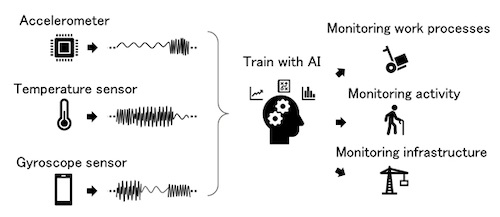 | | Figure 1: Examples of AI monitoring using time-series data |
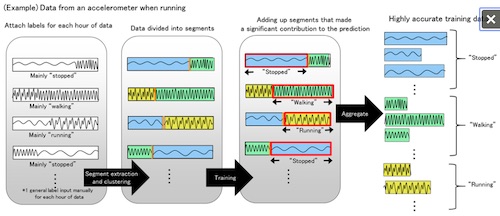 | | Figure 2: Diagram of the newly developed technology |
Time-series data obtained from sensors does not include anything other than every-changing numerical data. Therefore, in order to create training data for use in machine learning, it was necessary to manually attach finely detailed labels to the data in accordance to its changing values, indicating what was done and when at each point where the numerical values changed. For this reason, huge numbers of man-hours were required, and the use of AI with time-series data had seen limited progress.
Now, Fujitsu Laboratories and Kumamoto University have enabled the automatic creation of highly accurate training data with appropriate labels for each action, just by manually attaching a single label to each longer time period, even if they include multiple actions, indicating the major action in that time period according to human judgement. Because this significantly reduces the number of man-hours required, this technology will accelerate the use of AI with time-series data. The new development is expected to enable easier installation of services such as fall detection, operational functionality checks, and abnormality detection for machines, in smartphones and various other devices.
Development Background
In recent years, with the evolution of technology such as the Internet of Things (IoT), it has become possible to obtain a large amount time-series data from a variety of sensors. For example, by developing a functionality in which AI can determine the meaning of the motions of people and objects from the characteristics captured by accelerometers, it is expected that advanced functionality for monitoring people and machines can be incorporated into smartphones and various equipment. In order to apply AI to this sort of time-series data, it is necessary to create training data to train AI.
http://www.acnnewswire.com/topimg/Low_FujitsuAIFig151019.jpg
Figure 1: Examples of AI monitoring using time-series data
Issues
Time-series data obtained from sensors consists of just numbers recording values from the sensors moment by moment, so it is necessary to attach meaning to the data indicating "what" (labels) and "when" (segments) in creating training data for AI. For example, data from accelerometers when a person goes running includes intermingled data from when a person is running, when they are walking, and when they are standing still. So in order to create training data for AI, the data needs to be separated into segments, and labeled as "Running" "Walking" and "Stopped."
Conventionally, to create this sort of training data, the typical process was to record a video of the behavior while measuring the time-series data, identify the type of behavior seen with the changes in the numerical values at a second-by-second level, and manually attaching the labels. Because this process required a significant amount of work and time, the application of AI to time-series data saw limited progress, and there was a demand for a technology to automate the labeling process and reduce the workload.
About the Newly Developed Technology
Now, Fujitsu Laboratories and Kumamoto University have developed a technology that can automatically create highly accurate training data that enables the use of AI with time-series data, just by inputting a label expressing the main action underway over a longer time segment (for example, one hour). The features of this newly developed technology are as follows.
1. Extracting appropriate segments
Looking at time-series data, this technology can learn characteristics of times when the same activity is ongoing and characteristics of times when the activity changes, and can then automatically extract appropriate time periods from time-series data with actions based on same characteristics(1).
2. Highly accurate labeling
With this technology, users attach a single broad label for long segments of data (for example, one hour), such as "running" if the majority of the segment is spent running. After a deep neural network is trained to predict such labels and the resulting estimated labels can be used to calculate the segment of the time-series data that most contributed to that prediction. Also by adding up the time periods that have a high degree of contribution as label candidates, this system can create training data capable of accurate prediction.
http://www.acnnewswire.com/topimg/Low_FujitsuAIFig251019.jpg
Figure 2: Diagram of the newly developed technology
Effects
Fujitsu Laboratories and Kumamoto University conducted a trial where they attached labels to time-series data from accelerometers while performing mock work processes in a factory such as polishing. As a result, they confirmed that this technology was able to correctly label 92% of time periods. They judged that this was equivalent to the highly accurate results obtained when using data that was manually labelled in detail as training data. With this technology, one can easily create training data for AI use from time-series data, and further development is expected for the functionality that uses AI to determine activities captured by sensors. In addition, because this technology makes determinations based on just the numerical characteristics of time-series data, and does not rely on the type of sensor, it could also be applied to time-series data obtained from devices such as temperature sensors and pulse wave sensors.
Future Plans
Fujitsu Laboratories and Kumamoto University aim to conduct field trials using time-series data from a variety of fields, with the goal of commercializing this technology as a preprocessing technology for time-series data as part of Fujitsu Human Centric AI Zinrai, Fujitsu Limited's AI technology, during fiscal 2019.
(1) Automatically extract appropriate time periods with actions based on same characteristics from time-series data Using technology from Kumamoto University.
About Fujitsu Laboratories
Founded in 1968 as a wholly owned subsidiary of Fujitsu Limited, Fujitsu Laboratories Ltd. is one of the premier research centers in the world. With a global network of laboratories in Japan, China, the United States and Europe, the organization conducts a wide range of basic and applied research in the areas of Next-generation Services, Computer Servers, Networks, Electronic Devices and Advanced Materials. For more information, please see: http://www.fujitsu.com/jp/group/labs/en/.
Contact:Fujitsu Laboratories Ltd.
Artificial Intelligence Laboratory
E-mail: time-series-labeling@ml.labs.fujitsu.com
Fujitsu Limited
Public and Investor Relations
Tel: +81-3-3215-5259
URL: www.fujitsu.com/global/news/contacts/
Source: Fujitsu Ltd
Sectors: Electronics, Enterprise IT
Copyright ©2026 JCN Newswire. All rights reserved. A division of Japan Corporate News Network. |
Latest Release

JCB Contactless Expands to Metro de Madrid Enabling Seamless Tap-to-Ride Access Across the Network
Jun 23, 2026 12:00 JST
| 
Fujitsu honored with record-breaking 8 awards at AWS Japan Certification Award 2025, recognized for AI and cloud implementation and talent capabilities
Jun 19, 2026 23:58 JST
|
Fujitsu spotlights dynamic transformation for business in an AI era as the core theme for the Fujitsu Technology and Service Vision 2026
Jun 19, 2026 23:15 JST
| 
New Heat Dissipation Device Design Achieves a 47% Weight Reduction in an NTN Planar Antenna
Jun 19, 2026 22:39 JST
| 
Hitachi Energy bolsters the regional transformer market with strategic investment in North America
Jun 19, 2026 22:15 JST
| 
Japantastics Introduces Sato Mokko to the World -- A New Chapter in Japanese Artisanal Craftsmanship
Jun 18, 2026 08:00 JST
|
Hitachi expands its work with OpenAI to accelerate AI-driven modernization and cybersecurity
Jun 17, 2026 14:54 JST
|
Fujitsu and IBM Japan collaborate on modernization to support enterprise digital transformation
Jun 17, 2026 14:23 JST
|
Sharp to Introduce AQUOS R11 Smartphone
Jun 17, 2026 13:59 JST
| 
Honda to Begin Supplying Three High-output Models of the eGX Electric Power Unit Series for Commercial-Grade Work Equipment
Jun 17, 2026 13:44 JST
| 
Eisai Announces Strategic Investment Supported by the UK Government's LSIMF
Jun 17, 2026 13:28 JST
| 
BAE Systems and NEC Sign MoU to Strengthen Japan's Active Cyber Defence
Jun 17, 2026 13:10 JST
| 
Anime Tokyo Station Early Summer Festival
Jun 17, 2026 11:00 JST
|
Hitachi Energy expands zero-emission power portfolio with HyFlex Compact
Jun 13, 2026 00:06 JST
|
Hitachi Energy unveils AxoniQ: game-changing solution for the next era of transmission grids
Jun 12, 2026 23:42 JST
| 
Team Mitsubishi Ralliart Confirms Triton Readiness as It Targets Second Consecutive AXCR Title
Jun 12, 2026 23:20 JST
|
Report verifying the net carbon impact of NEC's agricultural solution, CropScope, published as part of the Net Carbon Impact initiative promoted by the EU Green Digital Coalition
Jun 12, 2026 21:40 JST
|
NEC's Face Recognition Walkthrough Gate for JR East railways wins "Best of the Best" at the "Red Dot Design Award 2026"
Jun 12, 2026 13:29 JST
|
Mitsubishi Motors to Launch All-New Eclipse Sportback EV in the United States and Canada
Jun 10, 2026 23:15 JST
|
Bosch Home Comfort Group and Hitachi Group agree to collaborate on Intelligent connectivity and diagnosis solutions for Commercial Air Conditioning based on "HMAX for Buildings"
Jun 10, 2026 22:47 JST
|
More Latest Release >>
|